Agriculture & Agrotourism
The Story Behind the Orchards You Visit
Citrus, durian, asparagus, and coffee aren't just souvenirs or scenery along Pelaga and Belok/Sidan's agrotourism routes. Behind them is farmers' knowledge passed down through generations, and crop-care practices that keep evolving season to season.
Four Key Crops
- Citrus
- Durian
- Asparagus
- Coffee
Stories from Pelaga's Citrus Orchards
Not a farming manual from a government extension program, but oral knowledge observed and passed down by farmers themselves, orchard to orchard, season to season: one of the most rarely written forms of cultural heritage.
Sources
- I Wayan Debot, Head of Bukian Hamlet
- Gunaba, citrus farmer in Pelaga
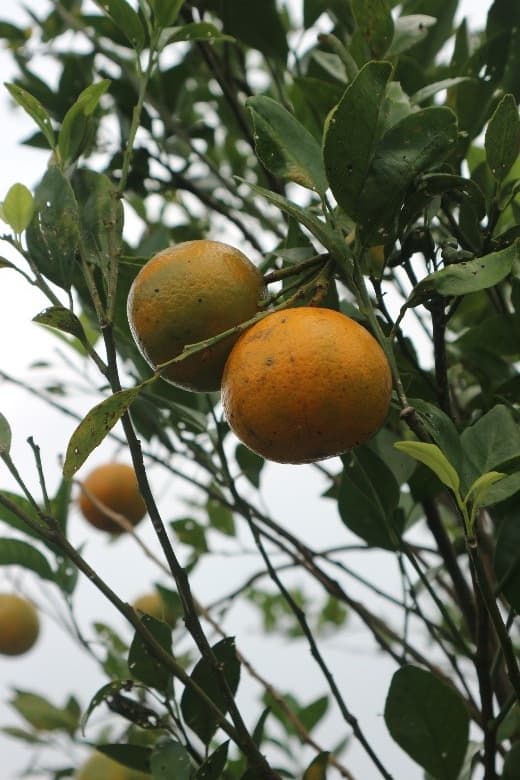
Citrus orchards in Pelaga might look like nothing more than a stretch of green on a hillside. But to the farmers who walk down to them every day, the trees “speak”: through leaves that change color, fruit that suddenly drops, or bark that starts to rot.
Over several weeks, this unit's research team walked through citrus orchards in Pelaga and talked with farmers to document something rarely written down: knowledge they gathered themselves, passed down over generations, not learned from books or government extension programs.
When the Citrus Trees Get “Sick”
For farmers, citrus disease isn't a medical concept: it's something recognized through visible change. Pak Kadus Wayan Debot has his own term for unhealthy leaves: yellow, but an “uneven” yellow, still mixed with patches of green. There's also a pest locals call “pipi”, which is actually a leaf beetle.
Vocabulary like this matters because it comes from years of watching the same orchard. Diagnosis starts with whichever part of the plant shows symptoms first (usually the leaves or flowers) before it spreads elsewhere. The enemy both farmers named most often, unprompted, was the fruit fly.
“Pipi”, the local term for a leaf beetle, one piece of vocabulary born from years of watching the same orchard.
One Pest, Two Stories
Asked when fruit flies arrive, Pak Kadus and Pak Gunaba don't fully agree. Pak Kadus believes they show up just before the dry season, roughly March through August, coinciding with flowering, and in his view, weather doesn't matter much. Pak Gunaba instead ties their arrival to the rainy season, when flowers start to drop and young fruit forms, about the size of a marble.
The disagreement doesn't mean either of them is wrong. This is exactly where local knowledge shows its true face: it isn't uniform, it's built from observing each individual orchard, and it keeps adjusting season to season. What's consistent between them is one pattern: risk rises around flowering through young-fruit formation, and whoever experiences it first links it to whatever weather is happening at the time.
Local knowledge isn't uniform: it's built from observing each individual orchard, not one rule that applies the same way to every farmer.
Between Store-Bought Pesticide and Homemade Mixes
When a plant falls sick, not every farmer has the same access to treatment. Pak Kadus sprays a product called Risotin, though he admits the pest disappears only to return within three days. Pak Gunaba says he rarely uses pesticide because it's expensive: when he has no choice, he mixes up to three different bottles himself, a practice locals call “ngoplos”, though he can't quite recall where he learned it.
Treatment isn't cheap either. Spraying 500 trees in one go can cost around Rp500,000, and it needs to happen regularly: twice a week in the dry season, dropping to once a month once the rains arrive. Beyond chemicals, there's also an older practice: rotten fruit is simply left where it falls, becoming natural fertilizer for the orchard soil.
When Harvest Meets Market
Many decisions that look like “plant health” decisions are really economic ones. Pak Kadus says citrus is often picked early, before it can drop or rot, because middlemen from Pelaga and neighboring villages are already waiting. Pak Gunaba adds that prices can rise if harvest is held back a little longer, but the longer farmers wait, the greater the risk of pests damaging the fruit first.
Ironically, citrus prices often crash right when the main harvest arrives. When supply is abundant, selling prices drop. For farmers, this is a challenge just as real as disease itself.
One thing becomes clear from these conversations: the knowledge Pelaga's citrus farmers carry isn't static. It keeps adjusting to shifting weather, rising pesticide prices, and an unpredictable market. Documenting this knowledge is their way of tending to the village's collective memory of how to survive alongside the plants they care for.
Download Full DocumentFruit Fly Risk Indicator
Read the way farmers read it, not from weather data, but from the patterns of flowering, young fruit, and harvest they've observed themselves, year after year.
High Alert
The one month both farmers flagged as risky: check orchards more often.
Caution
Flagged as risky by one of the two farmers: monitor flowers and young fruit regularly.
Harvest Season
Focus on protecting ripe fruit from damage, while staying alert for pests.
March is the one month both Pak Kadus and Pak Gunaba flagged as risky: check leaves and flowers more often this month.
A Note on Method
Pak Kadus says fruit flies arrive just before the dry season (March–August, during flowering) and don't appear in the rainy season. Pak Gunaba instead ties them to the rainy season, when flowers drop and young fruit starts forming, with harvest in August–October.
This calendar shows both versions as they were told, the disagreement itself is a meaningful finding: local knowledge is shaped by observing each individual orchard, not a single rule that applies the same way to every farmer.
A New Layer of the Same Wisdom
Reading symptoms from leaf color and swapping stories between orchards is one layer of knowledge. Farmers in Pelaga and Belok/Sidan are now also embracing another, Integrated Pest Management (IPM), a more structured method for protecting citrus, durian, asparagus, and coffee, four crops that shape this area's identity just as much. Not a replacement for oral wisdom, but a new layer of the same story: how residents keep learning to care for the land they live on.
Citrus
Citrus spp.
4 diseases/pests covered
Durian
Durio zibethinus
4 diseases/pests covered
Asparagus
Asparagus officinalis
4 diseases/pests covered
Coffee
Coffea spp.
5 diseases/pests covered
Six Principles of Integrated Pest Management
Healthy Seedlings
Use certified, disease-free seedlings.
Orchard Sanitation
Clear away plant debris and diseased parts.
Good Drainage
Avoid standing water around the root zone.
Regular Monitoring
Inspect regularly for early symptoms.
Resistant Varieties
Choose varieties resistant to disease.
Targeted Control
Combine biological and chemical control as recommended.
Take the Healthy Orchard Guide With You
Download the full visual Healthy Orchard (Kebun Sehat) guide as a PDF: symptoms, prevention, and treatment for diseases and pests across each crop. Currently available in Indonesian only.
See It for Yourself at the Agrotourism Orchards
Visit Agro Farming & Cultural Hub to see the citrus, coffee, and asparagus orchards behind this story, or explore the area's other sacred trails and cultural rituals.