visitbelokpelaga
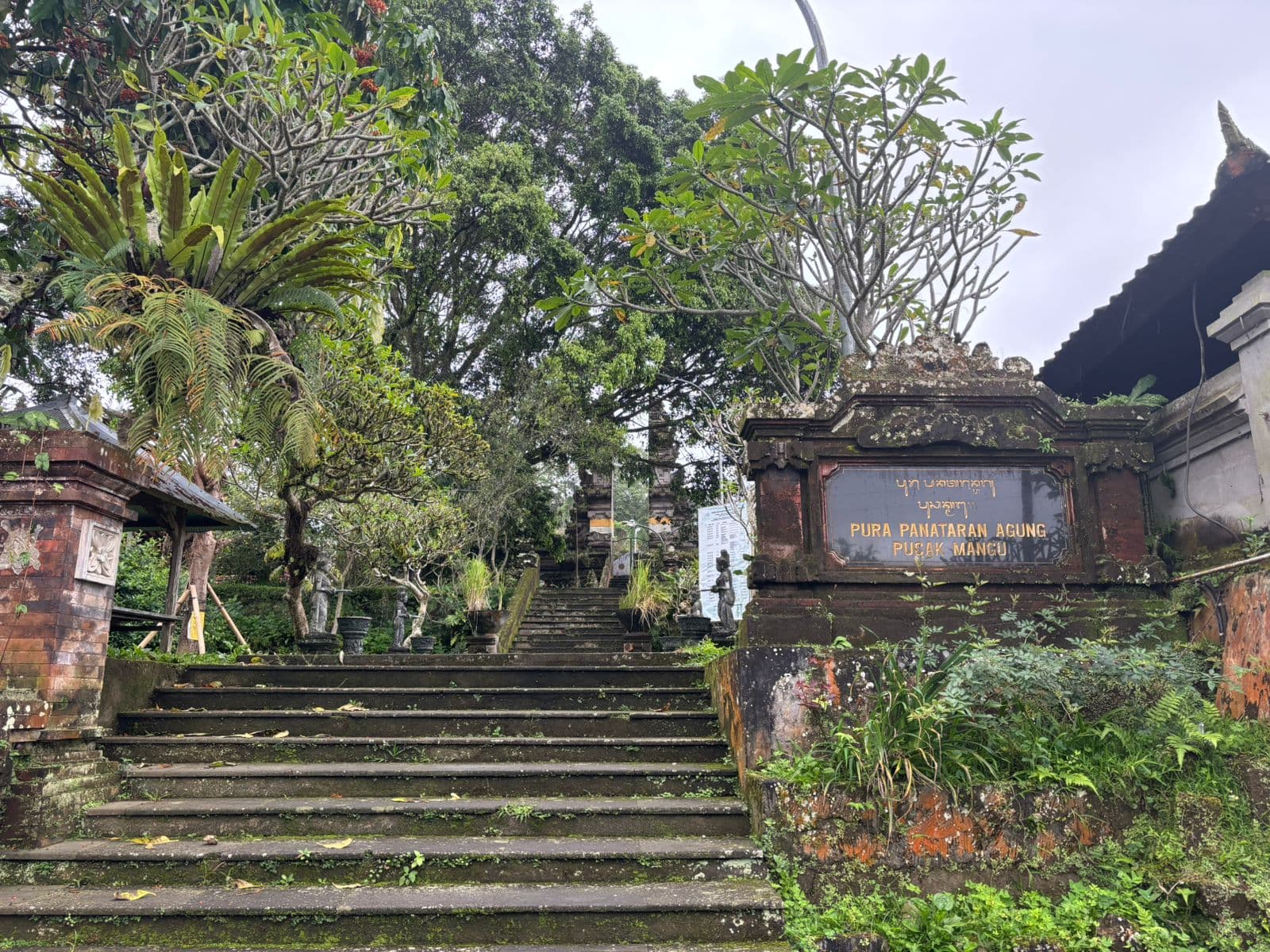
Tangga batu berlumut menuju Pura Panataran Agung Pucak Mangu, diselimuti kabut dan pepohonan tropis

Culture

Passed Down Through Generations

Culture in Pelaga and Belok/Sidan lives through stories passed down generation to generation: the origin myths behind sacred temples, ceremonies repeated every full and new moon, and oral literature not yet fully written down.

Sacred Trails

Tracing the Sacred Trails of Pelaga

In Desa Pelaga, sacredness doesn't live in a single place. It spreads out: from a mountain peak reachable only by a breathless climb, down to a valley where water has flowed from a rock crevice since before anyone can remember, to the base of a waterfall that now greets tourist cameras more often than prayer.

This unit's culture research team traced all four points, not as outside observers but as people who stopped by, asked questions, and listened: ancient mythology sitting alongside entrance tickets, a Megalithic-era lingga sharing space with pre-wedding photoshoots, ancestral beliefs still upheld generation after generation even as the world around them changes fast.

Pura Puncak Mangu di puncak Gunung Catur diselimuti kabut

Pura Pucak Mangu

Where Defeat Became a Turning Point

Reaching this temple means climbing tropical forest at the peak of Mount Catur (2,096 masl) across four checkpoints, the last two demanding extra care. Its name rarely appears on general maps of Bali, but it's recorded in the Lontar Babad Mengwi as the place where the ancestor of the King of Mengwi, I Gusti Agung Putu, meditated after being defeated in battle and taken captive. From that point he rose again, gaining the spiritual power that became the foundation of the Kingdom of Mengwi.

But its history runs far older than that royal tale: a large lingga stone from the Megalithic era was found in the temple's main courtyard, long before Hindu influence reached Bali, a pre-Hindu site later folded into Hindu-Balinese narrative rather than erased. Today Pura Pucak Mangu holds status as one of the Sad Kahyangan Jagat (Bali's six pillar temples) as well as the Catur Loka Pala, and is increasingly drawing trekkers.

View Details →
Kompleks Pura Luhur Pucak Gegelang dengan meru bertingkat di bawah langit cerah

Pura Luhur Pucak Gegelang

A Curse That Became a Village's Name

According to a text passed among locals, Bhatara Ciwa once intended to create a mountain at this spot, before the intention was called off by Bhatara Guru. From that cancellation came the name “Nungnung” (Old Javanese for “cancelled”), along with an order to build a temple honoring Wisnu and Brahma on the same site.

Like Pucak Mangu, this temple is also believed to be a Megalithic-era site and holds Kahyangan Jagat status, tended by four traditional villages at once. In April 2023, a Karya Ngenteg Linggih and Mapadudusan Agung ritual series that had lapsed for roughly 50 years was finally revived, led by three high priests from three different griya.

Kompleks Pura Penataran Agung Bukian dengan atap ijuk bertingkat dikelilingi hutan lebat

Pura Penataran Agung Bukian

Water Older Than Its Own Temple

In a valley about 25 km from central Mangupura, this complex unites Pura Penataran Agung as the main temple with Petirtaan Ciwa Gangga to its east. Locals believe the spring there flowed before the temple was ever built, said to have been shaped by the claws of Kebo Iwo, the legendary figure from Bedahulu, now flowing through eleven separate water points.

One taboo here is one nobody dares break: elderly parents and wives are forbidden from entering the bathing area, only unmarried young men and offering-makers are allowed in. The temple's own caretaker fell seriously ill for eight months before being “called” to take over his father's duties there. Today the site is also open as a melukat (self-purification) spot for anyone, including non-Hindus, in the area outside the sacred grounds.

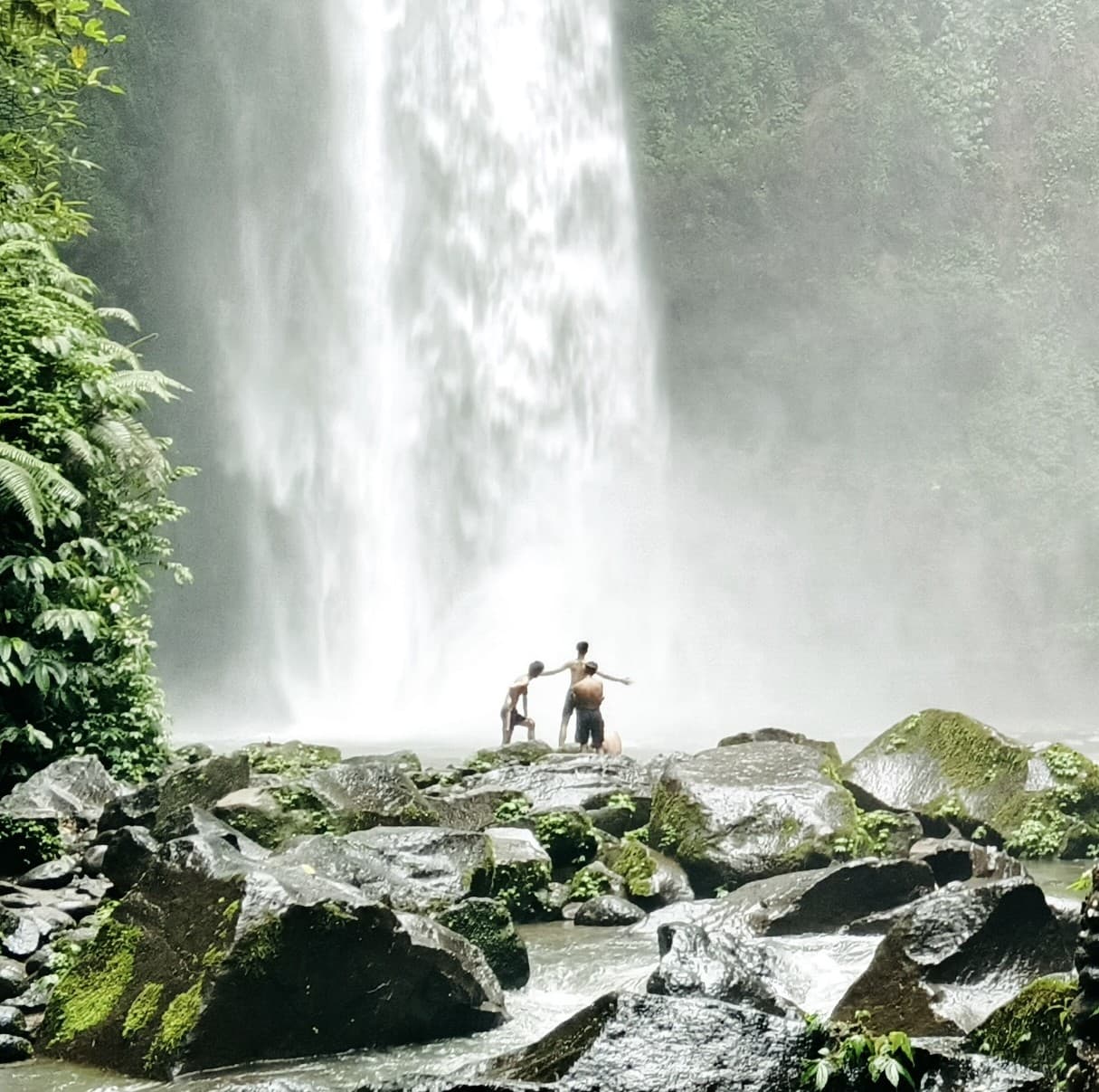
Air Terjun Nungnung yang mengalir deras di antara tebing hijau Pelaga

Air Terjun Nungnung

Where the Sacred Meets the Crowd

Unlike the previous three sites, Nungnung Waterfall is now far noisier with visitors than with mantras. Reaching its base means descending 480 steps (10-15 minutes for foreign tourists, 15-20 for local ones), and in the morning the falls often throw a small rainbow, a detail no brochure records but that locals still pass on by word of mouth.

A place that once had its own temple and odalan ceremony now has its spiritual function almost entirely replaced by recreation, dominated by foreign visitors, especially from Spain and Russia. Behind that lies local economic tension: ticket prices that haven't risen mean tour guides get no cut, something the ticket staff say has driven visitor numbers down.

View Details →

The sacred and the worldly in Pelaga are never truly separate. At Pucak Mangu, a Megalithic lingga shares its mountaintop with hikers. At Pucak Gegelang, a grand ritual dormant for half a century has been revived. At Bukian, old taboos over who may touch the sacred spring are still strictly upheld. At Nungnung, spiritual function has almost entirely given way to recreation. Pelaga is a village constantly negotiating with its own time: guarding what needs guarding, opening up what needs opening.

Download Full Document
Ethnographic Video

The Breath of Balinese Tradition

This ethnographic video captures the richness of Balinese culture through the Tilem and Purnama ceremonies in Desa Adat Bukian.

Both ceremonies are an essential part of Balinese Hindu spiritual life, reflecting the harmony between people, nature, and the divine (Tri Hita Karana). Through visual documentation and interviews with local residents, the video shows the meaning, process, and values held within each part of the ceremony.

Not just as tradition, the video also records a cultural identity that continues to be preserved and passed down from generation to generation among the people of Desa Adat Bukian.

Ethnographic Video

Sidan Strolling

This video presents local traditions, encompassing culture and spiritual rituals in Desa Adat Sidan, through the Sangkep, Ngiring Sesuhunan, and Purnama traditions.

These three activities show the strong relationships within the community and their bond with nature and God. Through short documentation and interviews with residents, the video shows how these activities are carried out and what they mean.

The hope is that, through this video, Desa Adat Sidan's local traditions can be accessed and preserved across generations.

Ethnographic Video

Understanding Barong: A Symbol of Prosperity for the People of Desa Sidan

In Balinese culture, the Barong is known as a symbol of the forces of good that maintain balance between good and evil. But beyond that, its presence also reflects the social condition of the community that upholds it, especially in terms of collective prosperity. According to local residents, the Barong isn't understood only as a religious symbol. “The Barong, that's a symbol of prosperity,” said one resident of the Sidan traditional village during an interview (11/07/2026). That statement offers a new way of seeing the Barong: beyond its artistic and spiritual dimensions, it has become something bound up with the everyday life of the Sidan community — close and deeply felt.

In this traditional village, stories and understanding about the Barong don't begin and end on a performance stage, but in the closest parts of daily life, like the rice fields. “So that when it passes by the plants, they turn out perfect,” he added. The people of Sidan believe the Barong acts as an intermediary between humans and nature. Through that statement, we can understand that the Barong also becomes a symbol of hope for the community's calm and prosperous continuity. Yet even though the Barong's identity is closely tied to Balinese society, not every village has one. “But it's rare for people around here (outside Sidan) to have a Barong. Rare in villages,” he said. That scarcity is what makes it special in two ways: (1) a Barong isn't property owned by an individual, but belongs collectively to a community, like a village; and (2) not every village even has a Barong in physical form.

Beyond being a symbol that brings prosperity to life, the Barong is also believed to carry hope for good during critical moments, and is trusted as a ward against misfortune, such as illness. In an interview, one resident explained that the Barong is usually brought out when many people in a place have died, as an expression of the community's faith in good things to come. “Its hair is given… its water is drunk… it's worn as a bracelet (made from the Barong's hair),” he continued, explaining that the Barong is also believed to be a cure and part of healing rituals. This shows that the Barong isn't just folklore or a symbol seen in public, but is also close to personal life, such as healing the sick.

The Barong doesn't stop at being a symbol of hope for community and individual life — it naturally also appears whenever local traditions are held. What makes it unique is that its appearances differ by place and occasion, following wherever it is practiced. In this Sidan traditional village, the Barong is customarily brought out during Buda Kliwon, among other occasions. “Only here, specifically,” the resident emphasized. Besides Buda Kliwon, it has also previously appeared at the Ngiring Sesuhunan ceremony, present as a revered symbol carried along by residents circling the village temple. Still, depending on the place, the Barong may also be used in other traditional ceremonies or customs according to local practice. This variation in Barong practice across Balinese tradition shows that culture may not run entirely uniform — but that culture is, in truth, something living, growing, and adaptive alongside its people.
Experience It in Pelaga and Belok/Sidan

See the year-round calendar of holy days and celebrations in the Guide, explore this area's cultural destinations, or read the citrus farmers' knowledge behind its agrotourism orchards.